The term ‘expressive Arts’ emerged through the Arts in Schools: Foundations for the Future work in 2022/3. This is how we describe the term in our annual Report Cards: “CLA has adopted expressive Arts as the collective term for Arts subjects in schools. In Wales, ‘Expressive Arts’ is one of six equal ‘areas of learner experience’ mapped on to four core purposes of schooling. CLA’s definition, as with the Welsh definition, goes beyond the existing four discrete art forms currently embedded in England’s system (Art & Design, Dance, Drama and Music) to include Film and Digital Media (which spans TV, film, radio and games design).”
We have long believed that adopting a collective term to describe Art subjects is helpful in giving clarity to their role as part of a defined curriculum area, in line with other subject areas such as the Sciences and the Humanities. Furthermore, this lends itself to the creation of Expressive Arts departments or faculties, which may be helpful in anchoring the role of the Arts within a school. Here our Senior Evidence Adviser Professor Pat Thomson, considers the term and its value to frame the Arts within schools.
The term “expressive Arts” emerged primarily from Romantic traditions that positioned the Arts as vehicles for individual feeling and authentic self-revelation, creating a counterpoint to more rationalist or instrumentalist modes of knowing. In contemporary Arts education, describing subjects as expressive typically distinguishes them from those perceived as primarily technical and/or reproductive. The Arts, according to this framing, aren’t just about acquiring predetermined knowledge but about generating something that originates from the learner’s inner world.
This individualistic interpretation does important work. It connects to the goal of individual development. It suggests a particular relationship between the person and their work, where expression implies an outward movement of something internal, emotions, ideas, perspectives, identity. The act of expressing is about communication and meaning-making, although the communicative aspect is sometimes downplayed in favour of therapeutic or developmental framings where the act of expressing matters more than what’s communicated or to whom (Biesta, 2017)1.
However, this dominant framing carries significant limitations. The language of self-expression can obscure the deeply social and cultural nature of artistic practices, making the Arts seem like spontaneous individual activities rather than culturally mediated practices. Expression always occurs through learned cultural forms and conventions, yet the rhetoric of personal voice and authenticity can make this fundamental sociality invisible.
A further understanding positions expression as always embedded in cultural materials and forms. Even the most personal artistic expression draws on inherited genres, techniques, symbolic systems, and aesthetic conventions. A child expressing themselves through dance uses movement vocabularies with social histories; someone expressing emotion through painting works within traditions of symbolism, composition, and mark-making. The expressive act isn’t private experience made visible but rather the use and recombination of available cultural resources. This understanding reframes expression as participation in cultural practices rather than extracting something pre-existing from within.
The term expression also implies relationality: it’s expression to someone, even if that someone is imagined or indirect. All expression anticipates and responds to others, occurs within communities of interpretation. The expressive Arts, then, become spaces where learners engage with how meaning is negotiated socially, how different audiences understand and value different forms of expression, how cultural contexts shape what’s expressible and through what means. This dialogic understanding relocates expression from the isolated individual to the space between people, where meaning emerges through exchange and negotiation.
The plural “Arts” is important too. Making the noun plural points toward multiple cultural traditions, not a single universal aesthetic. Different communities have different expressive practices, different relationships between feeling and form, different understandings of what art does and who it’s for. Recognising this plurality and diversity means acknowledging that learners encounter various cultural ways of making meaning, not a universal language of individual feeling. Expression becomes culturally specific and historically situated rather than transcendent and timeless.
Furthermore, expression need not mean articulating individual interiority. Community theatre and murals for example are deeply expressive, but their force comes from articulating common experiences, giving form to what groups feel and know together. Expression here becomes about solidarity and collective voice rather than isolated authenticity. The expressive Arts can make visible shared conditions and collective experiences, challenging the assumption that expression necessarily traces back to singular authorship or private feeling.
Expression is also constitutive rather than representative. Rather than expressing pre-existing feelings, the artistic process generates new ways of feeling, thinking, and being. The self isn’t expressed through the Arts but comes into being in the expressive process, through engagement with cultural forms and in relation to others. This moves us from a Romantic notion of an authentic inner self-seeking outlet toward something more social and emergent, where identity is formed through cultural practices rather than preceding them.
The challenge is that much Arts education doesn’t use the more social and cultural understandings of expression but defaults to the individualistic therapeutic model. Yet the term “expressive Arts” doesn’t necessarily foreclose richer interpretations. Recovering the inherently relational, cultural, and collective dimensions of expression allows us to position Arts education as something other than only facilitating individual emotional release or cultivating personal creativity. It also becomes about initiating learners into cultural practices of meaning-making, about learning how communities create and contest significance through aesthetic forms, about understanding how the social and the personal are mutually constitutive in artistic work. What appears as individual expression is always already collective, always culturally mediated, always in dialogue with others. Understanding this doesn’t diminish the Arts’ educational value but enriches it, connecting expressive practices to broader questions of cultural participation, social understanding, and collective meaning-making.
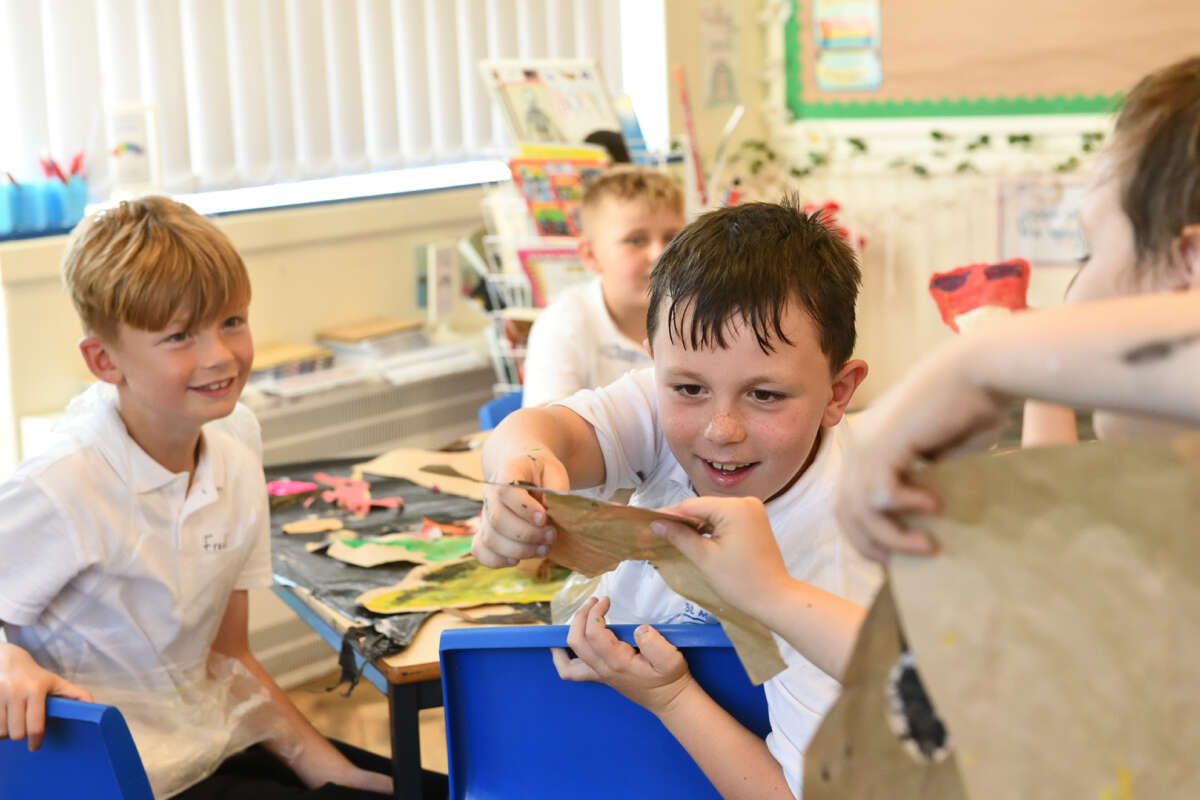
Image Curious Minds: Wigan Listening Project at Westleigh School | Credit Tom Edwards.
- Biesta, G. (2017). What if? Art education beyond expression and creativity. In C. Naughton, G. Biesta, & D. Cole (Eds.), Art, artists and pedagogy. Philosophy and the arts in education. (pp. 11-20). Routledge. ↩︎