
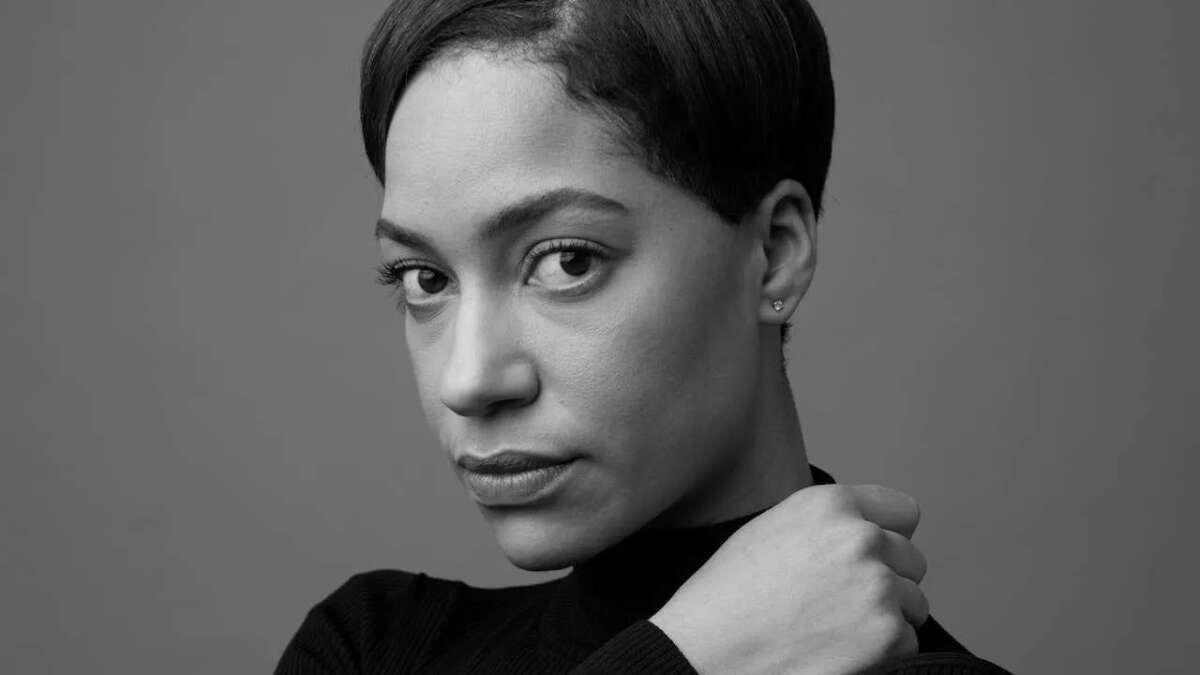
We reported last month that actor Cush Jumbo OBE – former Brit School student and now a Brit School Trustee – spoke in the House of Commons at a Society of London Theatre and UK Theatre event to launch their latest state of theatre report. Cush has kindly allowed us to publish her speech here to highlight the value of an Arts-rich education for every child – and the importance of a vibrant cultural sector in nurturing young talent.
I am an actress who works across theatre, film and television. I’m also a playwright and screenwriter and I can sing and dance and I direct when I have time. I’m a committed mentor to artists starting their careers and I executive produce my own show that I pitched and star in on Apple TV. My mother is very proud!
And although she’d love to take 100% credit for all of the many things that I have done and do, she knows that 95% of what I had the ability to do was ignited, nurtured and developed away from her because my love of arts started at school.
I started school in South London in 1990. I was the second of six children, and we moved around social housing a lot. I attended five schools in three boroughs of South London before I was ten years old, and I was constantly having to start again – or, as my sister said, make an entrance. But although each new school was different, what I really remember is the commonality in was their approach to the Arts: that was always the same.
Every school I attended before I was ten years old had a permanent music teacher. Every child was given an opportunity to learn at least one instrument before they left that primary school. And every school I went to had a raucous whole school singing assembly, which was held a couple of times a week.
Every school I attended taught drama once a week and put on annual plays or musicals utilising the known and unknown talents of the staff and the parents. Because parents had time then. Art rooms overflowed with coloured paper and pipe cleaners and poster paints and Copydex, which was my favourite, and ideas. The handwritten school newsletters always had a poetry competition for us to do over the weekend.
And we were all taken to the theatre on school trips. Not once before we left school, but many, many times. And not just to the West End Theatre, but to our local theatre. Mine was called the Catford Broadway. I think it’s called Lewisham Theatre now, but I liked Catford Broadway. I remember being taken to the local library to see a tiny touring production of the children’s puppet TV show Button Moon and being absolutely sure that the cast had created a direct portal to outer space in the middle of Bermondsey. How had they done this? Were they going to put outer space back in afterwards? It was also the first time that I became aware that making theatre was something you could actually do as a job. And I was completely blown away by it. And that was in a local library.
The point I think I’m trying to make is that I grew up with the idea that art was normal and access to art was normal. Art was also considered to be an important part of a child’s emotional, social and educational development, not a luxury side dish that you could live with or without. Access to art was also something that every child was entitled to regardless of personal economics.
Tickets to theatre and materials were either free or heavily discounted and outside of school, local dance troops and bands and choirs were affordable for all children due to the countless community centres and youth clubs that they could be run out of. I also remember teachers being a lot, well … happier. Their individual talents and life experiences were valued both by both the children and the parents and they seem to relish the opportunity to stay behind to paint scenery, teach electric guitar, or run the choir. I know I’m making this sound like a bit of a 90s utopia, but it really was a wonderful artistic time for a primary school child in the UK.
And this is proven by a whole generation of us that went on to not only pursue a career in the arts but become incredibly good at what we do after attending state primary schools in the 90s. The access to the arts I’d had as a younger student led me to, at age 14, to apply to the Brit School, also in South London, where I continued my creative education taught by expert practitioners alongside my GCSEs and my A Levels, until I went to drama school.
It’s at the Brit School that I believe access to an exceptional and specialised arts education made the difference for me in terms of what I was able to go on to do with my career and what I’ve been able to contribute to society more widely.
For anyone that doesn’t know, in the last 25 years, the alumni of the Brit School have won dozens of high-profile awards, including Grammys, Brit Awards, Oscars, BAFTAs and Olivier’s. This year alone, ex-students won four Grammys and five Brit Awards. You’d be hard pushed to find a West End show or a TV show being shot in the UK right now without an ex-Brit School student on the cast or on the production crew, making it the most successful performing arts school for students aged 14 to 18 in British history. And what does this school cost to attend? Nothing. It’s free.
The Brit School is funded at the same level as any other regular state school, but it needs three million more every year to fund the arts courses, equipment and specialised teaching that it needs. When I say arts courses, I don’t just mean the future performers you will see on stage, but the writers, the producers, the sound, the costume, the production designers, the digital designers, including CGI, gaming software, animators and teachers of theatre.
Teachers who are specialist practitioners who will go on to teach the next generation of performers. I was saddened and shocked to learn in the Cultural Learning Alliance 2025 Report Card that recruitment to initial teacher training for specialised art subjects like theatre are in crisis. There have been dramatic falls in recruitment averaging 66% across expressive Arts subjects from 2021 to the present day.
When releasing figures for their 2024 report card, the Cultural Learning Alliance had also worked out some other shocking statistics. The number of arts GCSEs taken had fallen by 42% since 2021, and 42% of schools now do not enter any pupils for GCSE drama. Nearly half. In the nation where Shakespeare was born!
I met one of my best friends at the Brit School at 14. Katie Sekiori is now head of the Brit School’s musical theatre department. When Katie teaches, she sets up hundreds of students for a successful artistic career and most of those students are in the West End shows that I was talking about. When I successfully pitch a TV show hundreds of people suddenly become employed overnight. So, Katie and I may be contributing to the creative life of this country and its economy in different ways but we both required an exceptional Arts education to do so.
I was asked to talk about early roles that I’d had and how those experiences impacted the trajectory of my career. But the truth is that for those of us that are built to do this, the prep for having the guts to walk into drama school or play a classical role at the National Theatre begins way, way earlier, as does the prep for being a fully rounded and productive member of society. School is where art needs to capture your imagination first.
Now is the time to fight tooth and nail for the children and young people currently in education and those coming next to have quality, free arts education. If we decide that we just don’t have the energy, if we can’t find the fight that we require, then I think that our world-famous British creative legacy, which so many artists have built before us, is essentially just going to be ours to lose.