
Welcome to the April edition of our newsletter. It’s another busy month for our sector, with news spanning an important performance measure consultation and CLA’s own consultation work on updating our Blueprint for an Arts-rich Education. Our Latest News digest this month features Education sector news:
- Department for Education Progress 8 consultation: respond by 4 May
- CLA’s own consultation work on a new sector-generated Blueprint for an Arts-rich Education 2.0
- An important new report on creative subject choices by students from 16 to Higher Education
- The challenge of building ‘inclusion bases’ in every school
- The number of pupils missing more than half of school rises – but suspensions fall
- Government plans for a new Careers Service
- Warnings of a growing crisis of masculinity in schools
- Student loan interest rates capped at 6% in England
We also have cultural sector news:
- Government response to the Hodge Review of Arts Council England published
- New report on research, development and innovation in the cultural and creative sectors
- A new report from Arts Council England on the state of theatre touring
And there are two Awards open to applications:
- National Arts and Cultural Education Awards 2026
- The 2026 Art Explora Académie des beaux-arts European Award (UK entrants are eligible!)
In Latest Thinking, we are delighted to share a print version of a speech actor Cush Jumbo OBE made in the House of Commons last month at a Society of London Theatre and UK Theatre event. Cush has kindly allowed us to publish her speech here to highlight the value of an Arts-rich education for every child – and the importance of a vibrant cultural sector in nurturing young talent.
We have a second Latest Thinking piece which is not in or standard article format. Instead, we are publishing in full a new CLA Briefing Paper: The Transformative potential of Arts Education for Inclusion by Professor Pat Thomson, CLA’s Research Associate. Pat produced a big piece of work on inclusion for CLA last year, in response to a consultation on inclusive practice, so we thought it was about time we shared an updated version of her work more widely. CLA’s current consultation work is taking a close look at the value of the Arts for inclusion, and this paper is particularly helpful in that context.
We also have our regular Research Spotlight article from Pat, who this month reports on a large-scale longitudinal study (focused on England and Wales) which asks an important question: do fine motor skills in the preschool years – the ability to draw, build with blocks, and fold paper – predict children’s later development? The findings are particularly interesting for early years Arts educators.
Finally, we are excited to publish our 2026 Report Card on 14 May, when we will also be co-publishing Rapid Evidence Reviews for Arts subjects which CLA has co-commissioned with the Royal Shakespeare Company. Look out for a special newsletter in mid-May in which we will share all of our new data and evidence.
In May we will also share details of two important consultations:
- SEND reform: putting children and young people first, which closes on 18 May; and
- Regulating post-16 vocational and technical qualifications at levels 2 and 3, which closes on 2 July.
Education sector
Have your say on the government’s Progress 8 consultation: respond by 4 May
Consultation
The government is seeking views on improving Progress 8 and Attainment 8 measures through a refreshed Progress 8 curriculum model. You can see details of the Key Stage 4 Accountability Measures consultation and how to share your views here.
The consultation also looks at a better way to recognise the progress of pupils with low prior attainment as part of improvements to the wider suite of additional performance measures; and extending the Department for Education’s Targeted RISE support to primary and secondary schools with low achievement. You do not have to respond on these questions.
Who should respond?
Anyone with an interest in education: teachers and school leaders or governors at all phases; cultural educators; anyone who cares about what is measured within our school system, and – from CLA’s perspective – how Arts subjects are valued through performance measures.
Background
The Curriculum and Assessment Review in November 2025 did not seek change to Progress 8: it recommended that both Progress 8 and Attainment 8 were retained, with no changes to structure or subject composition. It only recommended renaming the current EBacc bucket ‘Academic breadth’ bucket.
However, the government response to the Review went further, proposing welcome consultation to reform Progress 8: “We will consult on Progress 8 options to ensure that pupils can access a strong academic core and a breadth of subjects, including creative subjects. Working with the Office of Qualifications and Examinations Regulation (Ofqual), we will ensure we retain the rigour of exams whilst reducing the amount of time pupils spend in GCSE exams by 2.5-3 hours on average.”
Back in November we commented on how good it was to see the specific mention of “creative” subjects (which we took to mean Arts subjects). CLA saw this as implicit acknowledgement that the Progress 8 measure had been limiting breadth and student choice, including for Arts subjects.
The proposed changes
The proposed changes are a move in the right direction and will remove some disincentives for Arts subjects. However, we want to see a measure that will have meaningful impact on schools that have been prioritising EBacc subjects over time.
The existing Attainment 8 measure has been heavily weighted towards the EBacc: it contains three slots for EBacc subjects and three ‘open’ slots, which can be filled by any approved qualification, including up to three vocational and technical qualifications (VTQs). In effect, schools have been incentivised to prioritise EBacc subjects at the expense of other subjects, including Arts subjects – with the result that Arts subject take-up has been declining, as we reveal in our Report Cards.
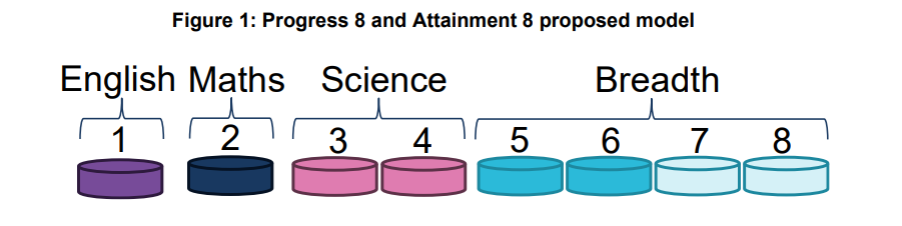
The new model is different. In the proposed new measure, slots for English and maths are retained but there are now two slots for science (replacing the old EBacc bucket), two for ‘breadth’ subjects and two ‘choice’ slots. ‘Breadth’ is defined as two of humanities, languages and ‘creative’ subjects. Choice is defined as any other subject where the qualification is not already counted in any of the other slots. The proposed model is set out in the diagram below.
If you want to read more we would suggest taking a look at pages 9-14 of the government proposal document here where you can see the consultation questions set out clearly on page 14. If you want more detail, you can also see the latest DfE technical guide to the consultation (published in February).
The final response is due in Summer 2026, with changes likely taking effect from November 2025/2026, intended for schools to use for pupils starting GCSEs in September 2027.
CLA COMMENT
CLA had long been calling for changes to performance measures (see our Blueprint for an art-rich education and the Arts in Schools: Foundations for the Future report).
In March, FFT Education Datalab helpfully examined how qualification entry patterns might change as a result of changes to Progress 8 – you can see their briefing here. As they summarise, with the end of the EBacc, changes were made to which qualifications could count in the eight slots comprising Attainment 8. These changes were designed to encourage a shift away from a curriculum geared towards the EBacc (GCSEs in science, humanities and languages) to a broader curriculum.
FFT Education Datalab reveals that currently around 68% of pupils fill all the available slots within the proposed new Attainment 8 measure – but 85% fill all the slots of the EBacc-heavy current version. It is therefore likely that qualification entry patterns will change, driven by the two new ‘breadth’ slots: “Given that most pupils already enter a humanities subject, we are likely to see increased entries in creative subjects and languages. This is likely to come at the expense of some of the EBacc subjects, particularly where pupils are taking three or more science qualifications or two or more humanities qualifications.”
The status of Arts subjects been negatively impacted by performance measures that do not value the Arts, so this is an opportunity to shift the dial: valuing the distinct contribution of the Arts within our education system within performance measures a key step. Accountability reform should focus on removing disincentives and enabling curriculum breadth, progression and quality, in line with the principles and recommendations set out in the Curriculum Review. New measures should enable pupil choice and ensure parity across subject areas so that Arts subjects are valued and given equal status to humanities and languages.
CLA observations on the proposal:
- VTQs: CLA was pleased to see vocational and technical awards being allowed in the breadth and choice slots, as we definitely want to see parity between academic and technical pathways. So, we would agree with question 13 in the consultation which asks, “Do you agree that Progress 8 should allow technical awards in the breadth and choice slots?”
- It’s might be a very crowded breadth bucket: Having so many subjects competing in the breadth bucket (humanities, language and Arts subjects) might not be helpful for Arts subjects, given how marginalised they have already become in many schools (as set out in our annual CLA Report Cards).
- We mustn’t introduce elements that undermine efforts to promote Arts take-up:
The consultation includes a question as to whether Science subjects should be added as a fourth category to the Breadth slot (alongside humanities, languages and ‘creative’ subjects’. This risks further crowding the Breadth slot – and disincentivising the Arts, undermining the intention of the reforms to rebalance the curriculum.
CLA concerns:
- Will it be enough to move the dial? There is still a risk for Arts subjects – the four ‘breadth’ and ‘choice’ buckets can still be filled without a single arts subject. Will it do enough to incentivise Arts subjects?
- It will not be quick and easy to bring the Arts back: The EBacc will have a long tail. Schools have been required to prioritise EBacc subjects over the past decade, focusing expertise and resource on these curriculum areas. Some schools might not have the resource to re-prioritise Arts subjects to the extent that a majority of students will have at least one arts subject in their ‘breadth’ buckets.
- Arts subjects should be described as such, or as Art and Design, not as ‘Creative’ – other subjects can be creative too. The conflation of ‘arts’ and ‘creative’ subjects is unhelpful: see our recent think piece.
Issues for Art & Design:
Beyond performing Arts subjects, there are other factors at play. Question 12 in the consultation asks, “What are your views on the inclusion of a fourth category (science) for breadth slots 5 and 6?” For Art and Design (A&D) colleagues, they are seeing A&D departments being merged with Design & Technology (D&T), with a resulting loss of A&D teachers. A&D is often put on a carousel with D&T, resulting in less time spent on visual art – this is the case at Key Stages 1 to 3. It is also the case that many non-specialist teachers/SLT don’t fully understand the differences between the two subjects, resulting in subject conflation.
Colleagues in the A&D sector think that in terms of pedagogy and approach, there might be a case for D&T having more in common with a scientific approach – A&D has more alignment with other Arts subjects than with D&T. However, there is a view that having a fourth science option would not help protect or encourage more time and resources for A&D. Additionally colleagues don’t feel that having another science option shows real understanding of ‘breath’.
Paula Briggs, CEO of AccessArt, says: “We feel adding another science option in Progress 8 won’t address the complex issues affecting subject choice at GCSE; if anything, it risks further weakening a real sense of breadth by favouring similar types of learning over genuinely different disciplines.”
CLA would definitely be against including science as a fourth category for ‘breadth’ slots 5 and 6.
Beyond performance measures:
Beyond accountability measures, CLA is currently consulting on what changes in the wider policy environment will enable a revitalisation of the Arts in schools, and high on the list is workforce – teacher recruitment, retention and training is a key issue, and we will be consulting further on this soon. See the news item below.
Have your say
The consultation closes on 4 May, and we would strongly encourage you to respond to ensure that the Arts are not disadvantaged through the new reformed measure. It’s only a few questions. You can share your views here.
The subject associations for Music have helpfully been particularly active on this issue. You can see really helpful guidance from the Independent Society of Musicians (ISM) here which includes suggestions on how you might wish to respond to the section about Progress 8 (Questions 11 to 15) – and similar from Music Mark here. You can see the UK Theatre guidance on responding here and guidance from the National Society for Education in Art and Design here.
CLA consulting on a new sector-generated Blueprint 2.0
In 2024, CLA published its sector-generated Blueprint for an Arts-rich Education for Every Child. The Blueprint set out the policy changes needed to secure equitable access to high-quality Arts education. In November 2025, the Government’s response to the Curriculum and Assessment Review confirmed a significant shift in direction that aligns closely with the ambitions set out in the original Blueprint. Our focus has now shifted from policy advocacy to implementation advocacy.
The original Blueprint set out the ‘what’; this new document, will set out the ‘how’. It is likely to set out:
- The key characteristics of an Arts-rich school
- the barriers to Arts education which need to be removed to create incentives for a revitalisation of the Arts in schools
- three key ‘enablers’ – the key infrastructure or system components/shifts which will support schools to deliver Arts subjects and enrichment and drive effective implementation of Arts education reform
We are in the process of developing this document through consultation with school leaders and arts educators. We have already run a roundtable with school leaders to consider the Arts teaching workforce. Our next roundtable will focus on the value of the Arts for inclusion; following this we will consult more widely.
The new Blueprint 2.0 will be a live implementation document: CLA will continue to refine and update it as policy, evidence and practice develop, supported by ongoing sector engagement, future CLA Report Cards and wider evidence gathering.
Look out for more on this work soon and do get in touch with your thoughts.
New report on creative subject choices by students from 16 to Higher Education
An important new study from the University of Cambridge examines how students have made creative subject choices across critical educational transitions; how individual, local, and institutional factors shaped these choices; and whether these creative subject choices later translated into creative employment.
The authors state that understanding these pathways is essential because of persistent concerns about inequitable access to creative education and creative employment in the UK. This is despite personal benefits to individuals that go beyond the intrinsic value of creative education, and the economic benefits to the UK economy from the creative sector.
Creative subjects are defined consistently across educational stages, from qualifications at age 16 to higher education, including art and design, dance, drama and theatre studies, film and TV studies, media studies, music, and photography, amongst others.
The study involved three cohorts from age 16 to the end of higher education. The key research questions were:
- What are the educational pathways into creative subject study in school, further and higher education?
- How do socio-demographic and educational characteristics shape young people’s creative subject choices over time, in school, further and higher education, and into employment?
- What are the current experiences of students, and the prior experiences of people working in the creative sector, around their choices and chances in relation to creative subjects, qualifications, and employment?
- How do institutional cultures and approaches shape individuals’ experiences and choices around creative subjects?
The results first trace preferences and intentions around creative subjects, including by educational background and socio-demographic characteristics. Creative subject choices are then explored at each respective stage in education – at age 16, post-16 and in further education and higher education – and then overall, to provide a comprehensive exploration of educational pathways. These pathways are also explored by gender, economic background, and by place and deprivation of areas of origin.
The report then addresses the transitions into creative occupations, before turning to further education, a sector which emerges from the evidence in this study as critical for creative study and creative employment. Finally, the study highlights institutional perspectives which the Arts-based qualitative data sources illuminate as shaping people’s choices and experiences around creative subjects.
The report’s conclusions can be summarised as follows:
- Progressively narrowing pathways: This research provides comprehensive evidence of a progressively narrowing pathway from early creative preferences, into creative subject choices, and to creative employment. This narrowing operates through multiple mechanisms at different educational stages, with cumulative effects that create substantial inequalities in who ultimately accesses creative careers.
- Socioeconomic disadvantage: This increasingly constrains creative participation as students progress through education. While early creative interests show only modest socioeconomic gradients, the influence of economic disadvantage intensify post-16 and through higher education. Interactions with gender point to women from economically disadvantaged backgrounds facing greater challenges to accessing creative subjects than their peers, which might explain some of the later gender imbalances in creative employment.
- The role of place and geography adds further complexity: Local deprivation and regional creative sector strength shape both opportunities and constraints in ways that interact with individual and institutional factors.
- Current patterns are entrenched: The strong association between creative higher education and subsequent creative employment, combined with the barriers faced by economically disadvantaged students in sustaining creative pathways, suggests that current patterns are more likely to perpetuate, rather than disrupt, existing inequalities in the creative sector.
The report’s recommendations are that:
- The value narrative is key: Policy recommendations focus on actively promoting the value of creative subjects for all.
- Recognising complexity: There should be recognition of the complexities of progression into, and experience of, creative employment.
- Challenging existing hierarchies: Emerging from the evidence is a strong push to challenge existing hierarchies: between further and higher education institutions; between creative and non-creative subjects; between different types of routes into later creative study or into creative employment. Options here are:
- Building on existing best practice around cross-sector collaboration, expanding links between further and higher education and the creative sectors in ways that some institutions already do.
- Supporting the post-16 transitions which the evidence points to as being particularly important for sustaining creative subject choices. This could be addressed through a simpler qualification framework; clearer communication to students about their options; and support to address any prior disadvantages emerging from available resources, personal or otherwise; and highlighting further education as a key route into creative study and creative employment.
CLA COMMENT
This report is well worth a read, and its findings align completely with CLA’s upcoming 2026 Report Card (due out in May): our Report Cards focus on the socioeconomic determinants at play in whether a young person pursues creative options from the age of 14, and the ways in which this continues to play out at age 16 and at age 18. All of our Report Cards describe a picture of progressively narrowing pathways, particularly for the most disadvantaged young people.
Our own Arts Education Capabilities Framework has been developed to promote the value of Arts subjects, and the upcoming National Centre for Arts Education will have a key role in promoting arts education to school leaders, teachers, parents, and young people, including promoting opportunities for children and young people to progress in the arts and pursue their interests and career aspirations.
One of the areas we are scrutinising as we develop our Blueprint 2.0 (see below) is how there could be clearer communication to students about their options to become Arts teachers – vital to the ecology of the cultural sector.
Challenge of building ‘inclusion bases’ due to regional disparities
As we reported in our February Newsletter, the Department for Education has made inclusion in mainstream education a key focus of its plans to reform the support system for pupils with special educational needs and disabilities. The government wants an ‘inclusion base’ in every school but lacks basic data on what specialist facilities already exist. New analysis by the TES reveals huge regional gaps in provision.
The TES stated that the government faces an “enormous” and “costly” task in establishing inclusion bases in mainstream schools because of patchy data and huge variations in existing provision. Because the number of informal support units already in place is unknown, raising questions about how the government will accurately target funding for new inclusion bases.
The TES analysis further reveals a “postcode lottery” in the availability of formal bases, highlighting the challenge of hitting the target in every part of the country. There are nearly 2,000 schools with formal bases, with some schools having more than one, but these are spread patchily across the country. Formal specialist bases consist of resourced provisions, in which pupils spend the majority of their time in mainstream lessons, and SEN units, where pupils spend most of their time.
Under the government’s plan, the new inclusion bases would comprise “specialist bases” and “support bases”. The former are commissioned and funded by local authorities, the latter by schools and trusts. These new terms will replace an existing system of “formal” and “informal” bases.
For example, 13.8% of London primaries are recorded as having one, compared with just 4.3% in the East Midlands and 5.4% in the South West.
Margaret Mulholland, SEND and inclusion specialist at the Association of School and College Leaders, said: “What this data shows is that putting a specialist base that caters for complex needs in every school is a big expectation, and something that many schools will need significant support to set up.”
The government has announced that £860 million will be shared across councils in 2026/7 as part of a £3 billion investment aimed at creating 60,000 new specialist places. The government will update the SEND Code of Practice and publish partnerships guidance to provide clearer expectations of the role of the local authority and local area partners in transforming the SEND system. Guidance is expected later in the spring on how councils will be expected to use capital funding to create inclusion bases.
You can see coverage in The Guardian here.
The DfE has also said it will continue to roll out “peer networks of best practice”, which schools will be able to access as part of the universal Regional Improvement for Standards and Excellence (RISE) Inclusive Mainstream programme.
Paul Whiteman, general secretary of the NAHT school leaders’ union, said: “The support available to families and children should not depend upon where children live, but too often funding and facilities for pupils with SEND are subject to an unfair postcode lottery, and this must change.” Whiteman advocates for planning and establishing SEND units and bases through co-production between councils, school leaders, parents and other key stakeholders to ensure they complement and build upon existing provision.”
CLA COMMENT
As we said back in February, proposals to reform the SEND system are set to be one of government’s defining policy changes and the government ambition has been broadly welcomed – but will be complex to deliver.
CLA has been thinking hard about inclusion in relation to its new Blueprint 2.0 and the value of the Arts for inclusion is likely to be a key focus area, spanning the value of the Arts for engagement and belonging; the value of the Arts for SEND pupils; and the value of the Arts for representation and relevance. Look out for more information on this soon.
Number of pupils missing more than half of school rises – but numbers of suspensions fall
The BBC has reported that the number of children missing more than half of their time in school has hit another record high in England, according to data from the Department for Education (DfE). A link to the DfE data is here.
Although overall attendance improved for most students in 2024/25, the number who were “severely” absent – missing at least 50% of their classes – rose again.
This was mainly due to a rise in pupils with special educational needs and disabilities (SEND) missing school, as the number of severely absent pupils without SEND fell when compared with the previous year.
The DfE says it has made “real progress”, with 225,000 more children attending school almost every day, but that it knows there is more to do for children with SEND.
Overall, absence rates for state schools have improved year on year, with the most recent figures showing the biggest improvement in attendance in over a decade, according to the DfE. However, the number of children missing half or more of their education has increased to over 175,000 students, a large proportion being children with SEND.
More than 5,000 more pupils with Education, Health and Care Plans (EHCPs) missed half or more of their schooling in 2024/25 than in the previous year, while the number of those without additional needs improved, the DfE says.
The DfE’s latest suspension and permanent exclusion data shows that the suspension rate fell in autumn term 2024/25, having been increasing each term since the pandemic.Data for the 2025/26 academic year so far suggests that the rate of suspensions is continuing to fall.
According to Education Datalab, it remains the case that disadvantaged pupils are disproportionately far more likely than other pupils to experience exclusion or suspension.
CLA COMMENT
Last month we featured a Latest Thinking article on pupil engagement which is relevant in relation to attendance; this new data reveals that pupils with SEND are most at risk of non-attendance, and that disadvantage plays a key role in increasing the likelihood of exclusion or suspension.
The Every Child Achieving and Thriving White Paper set out plans to draw up a new pupil engagement framework, with help from pupils, parents and schools. This will be published later this year and will allow all schools to measure the key factors that determine pupil engagement in education, and to make improvements. By 2029 the government expects every school to monitor pupils’ sense of belonging and engagement – currently around 60% of schools report that they measure factors around this.
The CLA Arts Education Capabilities Framework describes agency (autonomy, confidence, identity) and wellbeing (flourishing, pleasure, resilience) as being the two capabilities under a pillar of ‘being, becoming and belonging’ – and agency emerges as one of the most extensively documented benefits across all four of the Rapid Evidence Reviews for Arts subjects that CLA will co-publish with the Royal Shakespeare Company in May.
The Arts have a key role to play in pupil engagement with learning, and our upcoming Blueprint 2.0 consultation (see news item above) will reflect this.
Government plans new careers service
As reported in Schools Week the government is planning a new careers service by August 2027, but the current provider – the Careers and Enterprise Company (CEC) – is planning to bid for the contract.
The article states “A new careers advice support service for schools and colleges will replace the functions of the Careers & Enterprise Company, government has confirmed, but the organisation plans to bid to run its successor.” The CEC has been responsible for supporting schools with careers advice since 2014, when it was founded by then-education secretary Nicky Morgan – now its chair. It receives annual grant funding of around £30 million.
The DfE originally stated it had launched two opportunities for the delivery of services related to careers guidance in England. The text stated:
- CPD for careers advisers: Notice of a tender that went live on 8 April and is for the anticipated continuing professional development training for careers advisers in schools and colleges in England. This is the outcome of the initial policy to recruit 1,000 additional careers advisers. The tender will be to offer CPD training in six areas to at least 1,000 careers advisers. The contract is valued at up to £1.22 million, representing a new investment in careers training by the DfE. The contract is expected to commence on 1September and run until 31 August 2029 – meaning investment in CPD of around £400,000 per year, with an optional one-year extension. It is intended to provide six modular CPD courses to train at least 1,000 careers advisers ‘prioritising level 6 and level 7 professionals.
- Service to support careers provision: This is essentially a replacement for the current work of the Careers & Enterprise Company, with some changes to requirements. A market engagement event was hosted by the DfE for interested parties on 31 March 31, which was attended by at least 170 people. While not all of these will represent organisations likely to respond to the tender, it shows the level of interest in this area. The aim of the market engagement event was to gather feedback on the proposals before they are finalised into a tender, likely to be live in mid-August.
The five objectives of the service are to:
- Support schools and colleges to ‘deliver high quality careers programmes and drive continuous improvement’
- Support careers hubs – with an emphasis on increasing grant funding to hubs and allowing greater local autonomy
- Deliver enhanced support to young people with additional needs
- Raise awareness of technical and vocational pathways
- Increase employer engagement for the two weeks’ worth of work experience policy.
CLA COMMENT
The new study from the University of Cambridge referenced above – Creative Subject Choices: Student Pathways through Education and into Employment – is relevant here, in focusing on how creative subject choices translate into creative employment. If you enter ‘Arts’ or ‘Creative’ into the CEC website, there are no results.
The extended version of CLA’s Blueprint for an Arts-rich education calls for a focus on careers advice, entry and progression routes: “The Arts sector needs to see itself as providing education for employment, removing barriers and creating opportunities in order to build a creative workforce across all sectors, and a trained and diverse workforce for a thriving cultural and creative industries sector. The creative talent pipeline starts in schools, including in primary. The sector needs to be relevant to national education, skills and industrial strategies and to work with school careers programmes, connecting with post-16 education, including adopting the Gatsby Benchmarks, and offering work experience and entry-level jobs through apprenticeships.”
Our upcoming 2026 Report Card will include data on Arts apprenticeship take up for the first time.
CLA was pleased to see the tender document for the National Centre for Arts Education referencing careers in Priority 3 for the centre – “Promoting arts education to school leaders, teachers, parents, and young people, including promoting opportunities for children and young people to progress in the arts and pursue their interests and career aspirations.”
In 2025, when we consulted on our sector-generated vision and framework for the Centre, consultation participants went beyond the (then) scope for the Centre in their ambition, wanting it to embrace a “cradle to careers” approach. We were pleased to see this reference to careers in the new spec (in spite of the Centre’s scope being for ages 5-16).
As our vision and framework document states, in supporting clear pathways and progression, there was a desire for the Centre to “inspire children and young people to see creative careers as realistic and achievable options by supporting and enabling their introduction to diverse role models and showcasing the breadth of opportunities across the sector. Arts encounters should reflect the increasingly interdisciplinary nature of professional practice, helping young people imagine futures that span artforms and industries.”
We stated that the National Centre should connect with and complement wider national initiatives such as the Gatsby Benchmarks and the refreshed UK-wide Creative Careers Service, supporting these ambitions while remaining focused on its core role in arts education: “Arts education pathways should be seamless from Early Years to careers.”
We await news of who will be running the Centre and the new careers service (the tender for the latter is likely to be live in mid-August), and hope that a new approach to creative careers across all stakeholders will benefit all children and young people.
Warnings of a growing crisis of masculinity in schools
As the BBC reports, a teaching union has warned that a “masculinity crisis is brewing” in UK schools after almost a quarter of female teachers surveyed reported that they have been subject to misogynistic abuse from a pupil in the last year.
It is the fourth year in a row that NASUWT (the National Association of Schoolmasters Union of Women Teachers) has surveyed a rise in teachers reporting misogyny from pupils – up to 23.4% from 17.4% in 2023. The link to the NASUWT’s press release is here. The union is calling for a ban on social media for under-16s and a ban on phones in schools.
Matt Wrack, NASUWT’s general secretary, said that if female teachers are struggling to contain gender-based aggression, it is a “ticking time bomb.” Wrack said that teachers need increased support to deal with this “new frontier of behaviour management”.
Teachers reported being faced with misogynistic responses from pupils after trying to address concerns over their behaviours, with some reporting that they are ignored by male pupils due to being female.
Of the 5,087 teachers who took part in the survey across the UK, more than one in five said they have been subject to sexist, racist or homophobic language from a pupil in the past year.
Speaking to BBC Radio 4’s Today programme, Professor Lee Elliot Major – professor of social mobility at the University of Exeter – said teachers are acting as “de facto parents” in the classroom, explaining that a lot of “societal challenges” emerge in schools, saying that “The reality is that a teacher these days is a counsellor, a social worker, a poverty alleviator and a guardian of respectful values.”
A spokesperson for the Department of Education said misogynistic views are “learned” and the government is “committed to using every possible tool to achieve our mission of halving violence against women and girls”. The statement added that the department has updated guidance, is providing teachers with resources to recognise the signs of incel ideologies and is strengthening guidance for mobile phones in schools.
CLA COMMENT
One of the key capabilities developed through studying the Arts is empathy, as our evidenced Capabilities Framework demonstrates. Empathy is such a vital capability, with personal and societal benefits. It gives rise to:
- Compassion: sensitivity to the feelings, characteristics and circumstances of others
- Open-mindedness: understanding of the viewpoints of others
- Understanding and appreciation of difference(s): understanding of the circumstances and characteristics of others
In the workplace these are important for relating to others; respect; compassion and consideration for others; care of others; consideration of the state of mind and wellbeing of others; and sensitivity to impact on others. In wider society these are important for respect and compassion for others (individuals and groups); inclusion; countering hate; social bonding; social and community cohesion.
Using the Framework to influence programme development can support the development of pro-social behaviours that counter misogyny.
Student loan interest rates capped at 6% in England
In response to the developing issue of student loans, the government announced on 7 April that it is capping the maximum interest rates on Plan 2 and 3 student loans at 6% from 1 September, for the 2026/27 academic year.
Plan 2 and Plan 3 are UK student loan repayment types: Plan 2 covers undergraduate loans for those starting courses between 1 Sept 2012 and 31 July 2023 (England/Wales); Plan 3 covers postgraduate Master’s or Doctoral loans. The Plan 2 repayment threshold is £29,385 (from April 2026), and Plan 3 is typically lower (e.g. £21,000). You can find more details here.
This is an effort to deliver “protections for graduates from escalating student loan interest. This measure will protect students and graduates in England and Wales from the potential of inflation pressures due to the situation in the Middle East. Graduates will not pay the price for a war which the UK has no direct involvement in. This reform removes the risk of any temporary increase in inflation causing loan balances to compound at an unsustainable rate and is in line with actions taken in the past to secure stability in the student finance system.”
In its news coverage the BBC reported on the reaction to this by campaigners and the National Union of Students (NUS). Amira Campbell, NUS president, called it a “huge win” but said further change was needed – including reversing freezes to the repayment threshold announced in November’s Budget. “This government have woken up to the unfairness of student loans and are taking action to prevent our debts from spiralling further out of control,” she said. “But this change cannot come alone. We still need to see the chancellor stick by the terms we signed at 17 years old and raise the threshold in line with our incomes.”
Other campaigners have welcomed the announcement, but the BBC addressed repeated calls for wider reforms to the system: Oliver Gardner, founder of Rethink Repayment, welcomed the cap but said the “temporary measure is by no means a solution to the student loans crisis”.
Nick Hillman, director at the Higher Education Policy Institute, said while the change would be welcomed by many, it was “just a stopgap” that was “unlikely to assuage the concerns” of many graduates.
The government launched a call for evidence into student loans in England which closed on 14 April.
CLA COMMENT
As we said last month, It has become more and more challenging for young people who want to pursue study to HE level to shoulder the financial burden of the costs of course fees and living expenses. In May we will report on progression to higher education in England for Creative, Arts and Design subjects in 2024/25 and this new data will enable us to examine for the first time the extent to which socio-economic determinants are a factor in Arts subject take-up post-18.
Cultural sector
Government response to the Hodge Review of Arts Council England published
The Hodge Review of Arts Council England (ACE) was published on 16 December 2025, and the government published its response on 26 March. The content in relation to education was as follows (point 36):
Future generations of audiences, visitors, artists and professionals (Recommendation 11 in the Hodge Review):
Access to a high-quality arts education should be the entitlement of every child, not the preserve of the privileged few. We agree with Baroness Hodge that realising a high-quality arts education and creative enrichment for every child will require the combined efforts of government, the Arts Council and industry partners.
- We are revitalising arts education through reforms to the national curriculum, qualifications, accountability measures and enrichment. To support the implementation of these reforms, we are establishing a new National Centre for Arts and Music Education from September 2026. The National Centre – backed by £13 million funding over three years – will aim to ensure every child in England has more equitable access to high-quality arts education by providing strategic national leadership in revitalising arts in school, supporting excellent teaching in music, art and design, drama and dance, and promoting arts education opportunities.
- This is alongside £22.5 million of new funding over three years to create tailored, youth-led enrichment offers in up to 400 schools, across all types of enrichment activity, including arts and cultural activities.
- The Department for Education and DCMS will work in partnership to ensure there is strategic alignment across government funded programmes, including the Arts Council, to support arts education and enrichment – both in schools and communities. We will set out our plans, including to enable partners outside of government to align their funding and activities to contribute to this national mission, and we will convene an advisory group to support this work.
- The Arts Council will play an important role in realising this ambition. We will work with the Arts Council to improve access to the breadth of enrichment it offers via its National Portfolio, and other Arts Council programmes, ensuring they support the delivery of the Enrichment Framework and the benchmarks it sets out.
CLA COMMENT
The main take-way of note from the response is the formation of a cross-departmental advisory group to support alignment across the DfE and the DCMS, so we will wait to hear more about this and hope that the group might, in due course, be considering some of the following:
- Cultural sector responsiveness to school needs
- Strengthening accountability for cultural sector learning and participation
- Supporting the cultural education workforce
- Positioning Arts education to build a future-ready workforce
- Place-based evidence and data for the education work of cultural sector organisations
- Strengthening accreditation schemes as a driver of Arts-rich education
Our Blueprint 2.0 work (see above) will soon be focusing on the role of the cultural sector as a key ‘enabler’ to support the revitalisation of the Arts in schools, so we look forward to sharing more on this soon.
New report reveals that theatre touring is in crisis
According to the State of Touring report, commissioned by Arts Council England, theatre touring is in crisis, with performances of drama plays on tour having seen the biggest drop, declining by almost three-quarters between 2019 and 2024.
The report states that “This steep decline is a long-term and continuing trend, which is likely to reach a critical level without intervention.” Overall, the number of touring performances declined by 24% between 2019 and 2024. For drama plays, that figure was 72%, while musicals and dance each had reductions of almost 50%.
The key findings include:
- Touring is thought to be in a “poor state” and has “got … much harder,” though the picture is varied
- Organisations that produce work are also struggling, particularly theatre and small-scale combined arts and children’s/family work, plus work that is new or by emerging artists
- Larger scale commercial touring production appears to be flourishing, with growth in sales relative to five years ago and strong financial returns
- But venues are often struggling, with widespread moderate losses at the large scale, and more substantial losses at the small- and mid-scale
- Ticket prices for touring events have not risen with costs or inflation
- Tours are typically shorter and more concentrated in bigger cities
- Mid-scale drama and dance, and smaller scale productions, work by disabled and Global Majority artists, emerging artists, and innovative work face the greatest financial challenge, have decreased most and are most at risk
- Drama and dance have seen the biggest drop in touring
- Many publicly funded organisations made a loss overall in 2023
- Changing deals and the shift away from fees mean changes towards more mainstream programmes.
- ACE’s Let’s Create strategy is perceived to favour a shift towards a place-based agenda for National Portfolio Organisations (those funded by Arts Council England) and project grants, with uncertainty about the role of touring
- Consultees reported a net loss of experienced staff
- There is less collegiate working – many in the sector indicated the need to embrace a more collaborative and strategic approach.
The Local Theatre Touring Alliance welcomed the report, which it said, “provides important and timely evidence of the pressures facing touring across theatre, dance and music, particularly in venues outside major urban centres.” The Alliance said the report confirms “what many in the sector have been experiencing: increasing challenges in securing viable deals, sustaining audience demand and managing rising costs within existing touring models.”
CLA COMMENT
This decline can only be a bad thing for Arts education, as whilst not all productions will be for young audiences, the general data would suggest that there has been a reduction in the opportunities for children and young people to access high-quality productions across the country, and particularly beyond major urban contexts. It was good to see the report making a specific point about organisations that produce theatre and combined-arts work for children and families.
The government’s response to the Curriculum and Assessment Review stated that the “In addition to the core national curriculum and assessment system, the government is determined that every child has access to a wide range of enriching activities that broaden their horizons, stretch their abilities and build wider skills.” Arts and culture are included as one of five enrichment areas. Theatre-going is part of that enrichment, sometimes also connecting to curriculum work when pupils have the opportunity to see work on stage that connects to work in the classroom.
Any diminution of national touring represents a diminution of enrichment opportunities for children and young people, whether attending with their schools or their families. This report demonstrates the ways in which the health of the cultural sector connects to opportunities for schools, children and young people, and reminds us that if the Arts in schools are to be revitalised and an enrichment entitlement is to be put in place, then the cultural sector is one of the key ‘enablers’ that support this ambition.
New report on research, development and innovation in the cultural and creative sectors
A new report from the Audience Agency emphasises the significance of research, development, and innovation (RD&I) in the UK’s creative and cultural sectors, highlighting the current landscape, challenges, and policy recommendations to unlock its full potential.
Valuing Creative and Cultural R&D and Innovation draws together insight from across arts and cultural organisations and individual practitioners to gather a view of the current RD&I landscape – from independent artists creating new work to national institutions exploring the future of technology.
It considers the different definitions of RD&I used by government, funders and the sector, suggesting ways in which more inclusive framings and data could help to support growth and drive evidence-informed policy. It uses case studies to illustrate the overlapping areas of RD&I undertaken by arts and cultural organisations and practitioners: artistic, technological, place & societal and business, with environmental as a thread across all of these.
The future of the creative and cultural sector rests on its ability to innovate in the face of growing economic pressures, changing audience behaviours and fast-paced technological change. Without such innovation, there is a risk of not realising the full public benefit of the arts and culture, not capitalising on the opportunities for additional social impact, not benefitting from the full impact of artistic breakthroughs able to reflect society now, and not realising the potential for technological change brought about by innovators across the sector. The report’s headline recommendations are:
National strategy
- Establish clearer, joined up accountability and responsibility for co- ordination of policy and funding of RD&I across the creative and cultural sector, advocating for its value and making decisions based on evidence.
- Revise strategies and policies to recognise and value the creative and cultural sector’s essential role within the UK’s RD&I ecosystem, and as a driver of economic, social and environmental value.
- Evolve definitions and related guidance for RD&I in ways that recognise the fundamental role of creativity and cultural understanding in RD&I in all policy areas, industries, sectors and disciplines
- Use DCMS’s Cultural & Heritage Capital framework to recognise and value cultural and heritage assets as inputs to, and outputs of, creative and cultural RD&I.
Sector development
- Recognise and support activities that build the RD&I capacity of the creative and cultural sector, in particular its high proportion of freelancers and small-to-medium enterprises.
- Recognise that opportunity lies in the relationships between organisations and practitioners and the tacit knowledge and individual skills of the highly mobile workforce.
- Develop, attract and retain entrepreneurial talent at all levels.
Investment and impact
- Fund ‘Basic Research’ in and involving the arts and cultural sectors.
- Key creative and cultural RD&I funders to widen their support for entrepreneurship and risk taking within existing funding programmes and alternative financial instruments.
- Support local authorities and their local creative and cultural sectors to include arts and cultural RD&I within place-based funding bids and projects.
Undertake further research
- Develop an impact framework which recognises the contribution of creative and cultural RD&I to industrial RD&I, social innovation, the commercial experience economy and to the arts and cultural sector itself.
- Collect and make available granular evidence of creative and cultural RD&I activities including best practice in policy design, decision-making and making the case for investment.
CLA COMMENT
The report is important for our sector as it identifies four areas of RD&I: Artistic; Technological; Place and Societal; and Business – and the third of these, Place and Societal is relevant for our sector.
The Report states that “Place-based and societal innovation applies arts and culture knowledge, approaches and practices to create societal or place-based change or deliver improved outcomes. It creates positive social, health, wellbeing and experiential outcomes; some projects create this change for the whole of society, while others deliver outcomes for people in a specific place or for people who are members of a specific community or interest group. This innovation can take many forms, including:
- Engaging more and different people in arts and culture
- Delivering positive outcomes for people and places
- Developing inclusive practices that make art and culture more relevant and
- accessible for everyone
- Exploring the social and ethical consequences of innovation and new technologies.”
Three examples given under the Place-based and Societal RD&I themes are
- Hospital Rooms https://hospital-rooms.com
- Hood Futures Studios, Birmingham https://www.hoodfuturesstudio.com
- Artscaping, Cambridge Curiosity and Imagination https://cambridgecandi.org.uk/our-work/schools/amplifying-artscapers
It is important to link the arts education sector to this RD&I agenda, and our Capabilities Framework makes clear the positive outcomes of Arts subjects and experiences for children and young people on a personal and a societal level.
Open for entries: Awards 2026
National Arts and Cultural Education Awards 2026
Nominations are now open for the 2026 National Arts and Cultural Education Awards. The awards which are managed and led by Curious Minds shine a light on bet practice and innovation in the field of cultural and creative learning, wherever it is happening across the country. There are 10 Award categories in 2026.
- The Arts Leadership in Education Award
- The Inspirational Local Partnership Award
- The Innovators in Engagement Award
- The Mighty Roots Award
- The Fearless Freelancer Award
- The One to Watch Award
- The Young Arts Activism Award
- The Spark the Change Award
- The Power in Practice Award
- The Changemaker Award
Further information on the categories and how to nominate can be found here. The deadline for nominations is midday (12:00pm) on Monday 1 June 2026.
The 2026 Art Explora Académie des beaux-arts European Award
This Award is organised by Art Explora, an international foundation based in Paris, in partnership with the Académie des beaux-arts. These annual Awards champion innovation in cultural engagement. They are open to all non-profit European cultural organisations, from all artistic sectors – this includes the UK.
The Award supports innovative practices in audience access, participation and engagement that can be shared across Europe. The total amount of the European Award is €180,000, divided into five Awards.
The European Award encourages new forms of audience engagement and participation in Arts and culture, supporting innovative projects, across all art forms, that can be shared, replicated and scaled across Europe. Working against all social, economic and geographic barriers, the Award encourages access to arts and culture for everyone, and champions new dialogues between arts and audiences.
The European Award also provides a publication which highlights the best practice imagined across Europe, from Award laureates to the 20 shortlisted projects. It also summarises the workshops and round-table discussions hosted during a professional networking event, Arts & Audiences, which provides a chance to share, celebrate and discuss new methods of connecting with audiences.
Applicants are invited to apply to one of these three categories based on the organisation’s annual expenditure in the 2025 financial year:
- Category 1 Award of €30,000 (for cultural organisations with up to €200,000 annual expenditure);
- Category 2 Award of €40,000 (for cultural organisations from €200,000 to €1 million annual expenditure);
- Category 3 Award of €50,000 (for cultural organisations with over €1 million annual expenditure).
By submitting their application, candidates automatically become eligible for the Special Jury Award and the Audience Choice Award, each worth €30,000.
Last year there was a UK winner. Thames Festival Trust won for “Turning the Tide”, a major cultural engagement project by Turner Prize-nominated artist Catherine Yass, designed to challenge perceptions of disabled people in public space and empower disabled young creatives.
The deadline for submission is 26 June 2026 and all the information you need to apply can be found here.