
Liza Vallance, creative producer and consultant and former Deputy Director of Learning at the National Theatre, considers belonging – not just as an outcome of Arts education, but as one of the conditions that enables learning, creativity and participation to flourish.
Belonging by Design: Towards an architecture of belonging in Arts education
The relationship between Arts education and belonging is increasingly well evidenced. The Cultural Learning Alliance’s recent work places belonging alongside agency, wellbeing, communication, collaboration and other capabilities that Arts education can help develop. Its emerging new Blueprint for an Arts-Rich Education also recognises the role of the Arts in inclusion, engagement, representation and belonging. Lately I’ve been pondering on whether we’ve been putting belonging in the wrong place in the story.
A little confession. I bloody love evaluation. I see myself a bit like the Jessica Fletcher of evaluation, following the clues, uncovering the findings, smirking sagely as I share recommendations, from the comfort of a velour tracksuit. Over the last few years, I’ve evaluated participation programmes across theatre, music, heritage, schools and community settings. The projects and the people involved have been wildly different, but I keep noticing the same thing when people talk about what mattered. They rarely start with the artistic outcome. They talk about being welcomed, feeling safe enough to have a go, having an idea taken seriously. A project that belonged to an organisation starts to feel like it belongs to them. Which has left me asking:
What if belonging isn’t principally an outcome of Arts education, but one of the conditions that enables learning, creativity and participation to flourish in the first place?
- Belonging might come before confidence
Just like I love evaluation, evaluation loves an outcome. You’ll be familiar with them. Confidence increased. Skills developed. Wellbeing improved. But the more evaluation I do, the more interested I am in what happens before those outcomes appear. Young people don’t necessarily become confident and then contribute. Sometimes it works the other way around. Something about the room tells them their contribution is genuinely wanted. They take a small risk. Someone listens. They try again. Confidence might, in other words, be downstream of belonging.
That changes the question from what did this Arts activity produce? to what happened here that made change possible?
2. Participation isn’t the same as belonging
We can count attendance, and we can measure participation. There’s a difference between being allowed into a space and feeling that you matter once you’re there. This feels particularly important when we talk about inclusion. We rightly ask: Can I come? Can I take part? Can I see myself here?
Belonging adds another question: Will it matter that I am here? Representation allows people to see themselves within a space. Belonging means recognising that their presence might actually change it.
3. Belonging has an architecture
During a co-design process with participants of a music project for people experiencing homelessness, we explored why people kept coming back. Interestingly, nobody started with music. People talked about arriving, knowing somebody would be stood at the gate waiting for them. People reflected on being encouraged rather than told. On gradually being trusted with more and eventually becoming the person who helped somebody newer find their feet. I became slightly obsessed with how practical it all was. Belonging, which can sound enormous and abstract, was turning up in tiny, observable things. It seemed to have an architecture.
4. The tiny stuff isn’t tiny
Across very different projects, I’ve watched brilliant artists and facilitators pay extraordinary attention to things that can look almost inconsequential. How somebody is welcomed, whether names are learned, what happens when someone gets something ‘wrong’. This isn’t the fluffy stuff around the edges of the ‘real’ creative work. It IS the work! I’m not suggesting we can manufacture belonging. We can’t. It’s personal, contextual and relational. But I’m definitely suggesting we can design the conditions in which it has a fighting chance.
5. Contribution might matter more than participation
I’ve become particularly interested in the moment when somebody moves from receiving an experience to shaping it. You know the moment when a participant suggests something that changes the work? When they start saying ‘we’ rather than ‘they’? That tiny shift fascinates me. It suggests movement from access to participation, then contribution, agency and perhaps eventually shared ownership. So maybe one useful measure of belonging isn’t simply Did they participate?
Maybe it’s: did they come to understand themselves as someone who could change what happened here?
6. The Arts know stuff about belonging
Education theory has long recognised the relationships between learning, participation, identity and belonging. I’m certainly not claiming the Arts discovered any of this, but I definitely think we’re underselling what Arts practice knows.
Making something with other people requires negotiation. Whose idea gets followed? Who takes the risk? Who hangs back? Who gets heard? What happens when people disagree? How does something move from my idea and your idea to our thing?
Good artists and facilitators navigate this territory constantly. We tend to make the case that the Arts can produce belonging. Perhaps we should also be asking what artists know about how to create the conditions for it. That feels like a different, and potentially much more interesting, proposition.
7. An invitation: towards an Architecture of Belonging
I’ve started thinking about all of this as an emerging Architecture of Belonging. That sounds well fancy, I know. As ever, in my neurodivergent brain, I have more questions than answers. These are the ones I keep coming back to:
- What changes when people know they are expected rather than accommodated?
- What enables invitation rather than instruction?
- When does participation become contribution?
- How does representation become recognition?
- What enables agency, reciprocity and shared ownership to grow?
And, possibly most importantly for those of us in our velour evaluation tracksuits: how can we get better at noticing these conditions, rather than simply counting the participation they produce? Maybe the next question we should be asking is:
What does excellent Arts practice already know about the conditions in which belonging can flourish, and what might the wider education system learn from it?
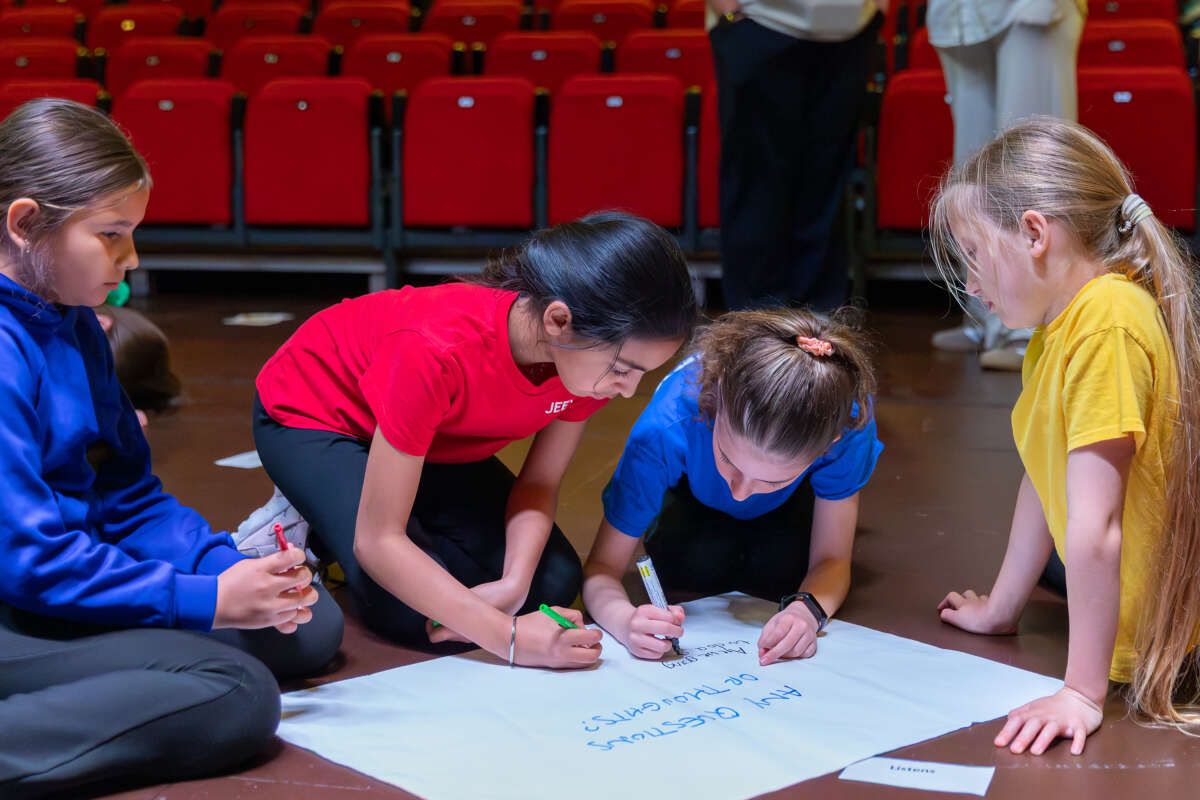
Image – Shakespeare Ambassador Training Coventry Schools. Credit Sara Beaumont for RSC